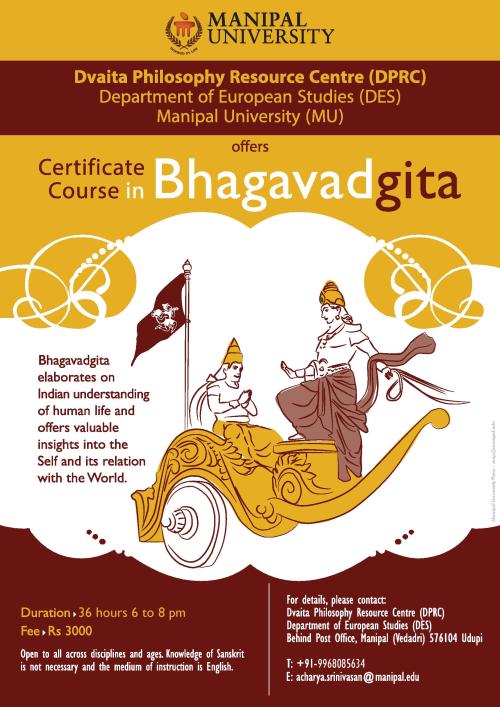
 Certificate Course in Bhagavadgita [3 MU credits]
Dvaita Philosophy Resource Centre
Bhagavadgita is a text of 701 verses comprising 18 chapters that elaborates on Indian understanding of human life and societies, their interactions with nature and universe, norms and principles based on Dharma and Niti; and ultimately, it inquires inward outlook of one-self and self’s relation with the worldly affairs. Many in fear of its religious doctrines keep Gita aside from academic discussions; however, it is not a mere canonical text that speaks on rites and restrictions. Gita’s inquisitive approaches to the concepts like moral dilemmas of rights and duties, science of deeds and fruits, descriptions of prescribed and preferred roles, ethical concerns of critical situations, different paths of actions and wisdom, importance of love and dedication and theory of neutrality contemporize it to times beyond limits. Interdisciplinary and multidimensional perspectives would help us to unravel the strangles and enrich our understanding of such literature.
Acharya Madhva, the recent among the three major philosophical thinkers of India has written two detailed expositions on Gita detailing and addressing several philosophical questions raised. He also addresses several questions raised about ethical stances of the principal characters of Indian epics and offers solutions to philosophical conflicts that otherwise arise, which will be looked into during the course. In addition, the course focuses to deal with Gita with an open and analytical approach aiming to understand the tradition of commentaries as well. During the course, other than the Course Instructor, subject experts may be invited to deliver special lectures on various pertinent topics.
To familiarize the learners about the historical significance of Mahabharata and Bhagavadgita.
To discuss the principles proposed in Gita and understand their relevance.
To analytically evaluate the different interpretations of Gita.
To enable the learners in the philosophical discourse on various interpretations of Gita.